Local Movers in San Angelo, TX
San Angelo Movers is set up for households and small offices changing address within the San Angelo area. On a local move the furniture is padded and wrapped, pieces that won't clear a door are taken apart, and everything is loaded, driven over, unloaded and reassembled in the room you choose. Local here means across town or out to a nearby community. Send both addresses and your date to get started.
Typical local jobs
Pick the one closest to yours:
An entire house or condo
Each room, along with the shed, attic, garage and basement.
A rental apartment
Buildings with shared stairwells and front entrances too; the apartment moving page goes into those in more detail.
Just one room
A dorm room at Angelo State, a home office, a nursery.
A small office or retail space
Desks, files, shelving and computers, often moved after closing time.
To or from a storage unit
At the start, the end, or both.
A single heavy piece
A couch, a gun safe, a treadmill or an armoire is a furniture move, not a whole-house job.
Within the same home
Two rooms emptied, then filled again, while new flooring goes in.
Going over a state line? Then long-distance moving is the page you need, since those jobs are priced and planned another way.
Keeping your furniture in one piece
Most moving damage comes from a short list of avoidable errors. This is how a careful crew heads off each one:
Before carrying starts, floors, door frames and stair rails get protected.
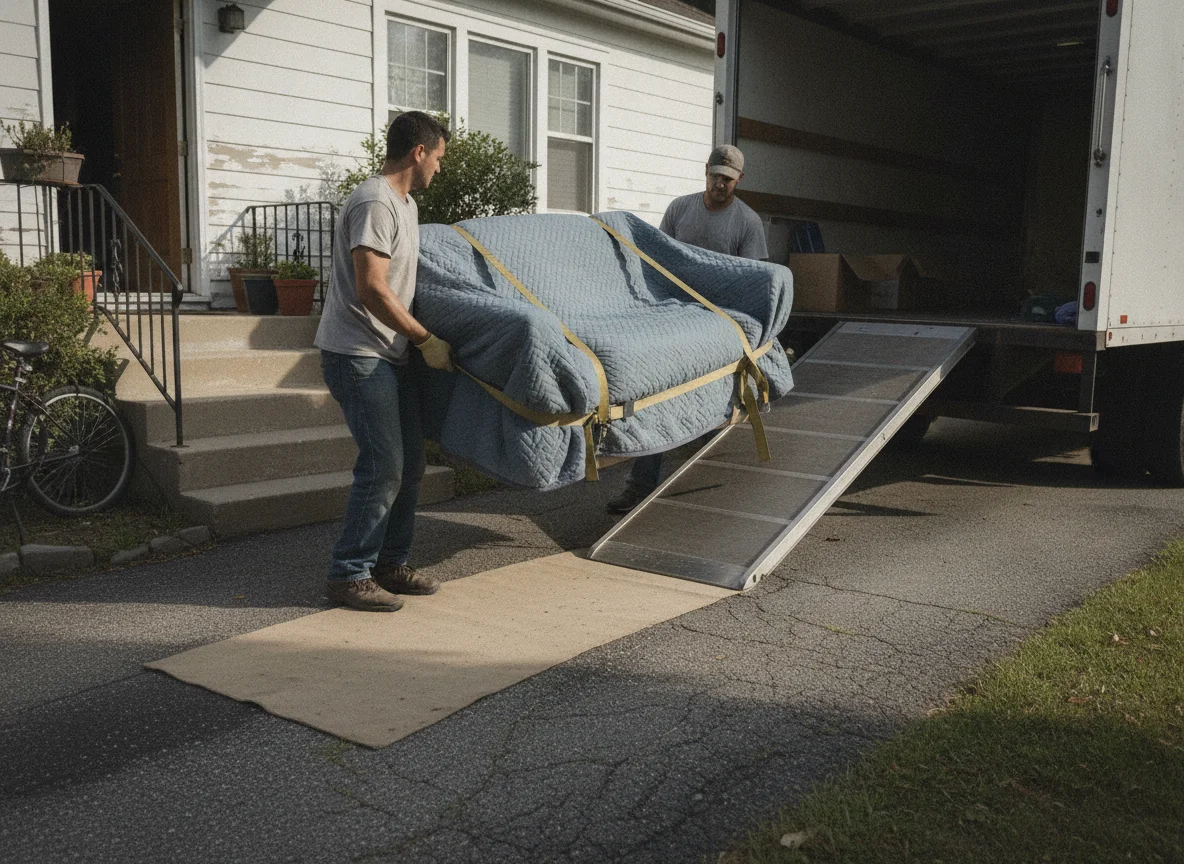
Carpet runners along the walking path, pads on the jambs, wrap around the banisters. In most moves the house takes more knocks than the furniture does.
Upholstered pieces get wrapped in pads, not just piled up.
Pads go on first, then they're taped, then the piece is loaded. Arms and corners scuff easiest.
Flat-pack stays in one piece whenever it fits through the door.
Particleboard rarely takes a second teardown: the cam locks and dowel holes wear out the first time, and a wardrobe that's been fully taken down often never stands square again.
Glass and stone tops ride standing on edge in a frame.
A slab of stone is weak across its face; carried flat, it can break from its own weight after just one hard bump in the road.
Sleeper sofas have the bed strapped shut before tilting.
Left loose, the frame unfolds in the doorway and damages the door casing, the sofa itself, or somebody's leg.
Large pieces are measured before anyone lifts them, not midway up a staircase.
Something that fits the room may still jam on the landing, and the bottom step is where to find out.
Mattresses get bagged.
An uncovered mattress that rubs a stairwell wall or sits on a driveway collects marks that never wash out.
Washer shipping bolts get refitted.
The drum hangs on springs, and without those bolts it slams into the cabinet all the way across town. Water lines, the drain hose and the fridge's ice maker line are disconnected and emptied so nothing drips onto other goods.
Televisions travel upright in a fitted box.
Never on their backs with weight on the screen.
At the new place, cartons go to the room written on each label, and beds and tables should be reassembled before the movers go.
What changes the cost
Two homes holding the same furniture can make very different moves, and volume is rarely the reason. The big factors:
Getting in and out at each end. How far, and how hard, it is from the front door to wherever the truck can stop. Stairs at either home, a long walk out to the curb, a narrow alley, a steep or sandy driveway, a gate too tight for a truck, or cars lining both sides of the road. Each of those repeats on every single trip between house and truck.
What needs taking apart. Bed frames, tables, shelves, and anything too big for a doorway in one piece.
How much packing is already done. Boxes sealed and marked in advance, or a kitchen still waiting to be wrapped, are two very different days.
The date. Month-end and the summer months are when most people move, so those slots fill first.
A sound estimate follows a walkthrough or video call, and Texas law has the mover put a written proposal in your hands before loading. Check the mover with the Texas Department of Motor Vehicles, and be wary of a phone price from someone who hasn't looked.
What to have on hand when you reach out
Just the basics:
Each address, plus which floor it's on
The date, and how flexible it is
A rough sense of the load; the bedroom count usually does it
Anything big, delicate or awkward, like a piano, a gun safe, a pool table, a big fish tank or a marble top
Whether you plan to pack yourself or would rather book packing services
That's all it takes to size it.
Tight timeline? Ask rather than assume, and see same-day moving for details.
Contact UsWhen a full move is more than you need
Said plainly, since it can save you money:
Studio or one-bedroom on the ground floor, nothing to take apart, and a rental truck or container already parked at your door?
Then loading and unloading help fits the job better: the truck stays in your hands, and the load gets packed tight so it won't shift on the road.
Only a few boxes, nothing big?
That's not really a moving job, and nobody gains by calling it one.
A few things can't ride on the truck at all.
Propane cylinders, gasoline, paint thinner, aerosols, pool chemicals, ammunition and fireworks can't go on a moving truck. Mowers, generators and string trimmers ride only once drained, with the spark plugs out.
Gas-fed and hard-wired appliances
These need a qualified tradesperson to disconnect and hook up again. Movers carry the appliance; they leave the gas line and wiring to that trade.
Keep what can't be replaced close.
Papers, prescriptions, jewelry, keys, laptops and keepsakes travel in your own vehicle. Pets do too, and so do houseplants on any longer trip.
Preparing for the big day
Boxes shut, taped, and marked with the room they're headed to. Books in small boxes, since a big box of books is too heavy to lift safely. Drawers cleared of liquids and fragile things, the freezer defrosted the night before, kids and pets in one closed room, and space kept clear out front. Furniture left behind can go to bulk pickup, capped at five cubic yards and run by the City of San Angelo Operations Department.
Across San Angelo, where the North and South Concho Rivers meet, and out to Alvery Junction, Bentwood, Miles, Mertzon, Paint Rock and Robert Lee.
Questions we hear
When should I book my local move?
Once your date is settled, get it on someone's calendar. The final week of each month and the summer stretch are claimed first, so if your date falls in either of those, reach out well before the first box is even packed.
What if something is broken during the move?
Before you agree to anything, ask each mover what protection covers your belongings, how it is calculated, and what the higher tier adds. It's a reasonable thing to ask, the answers differ more than most people expect, and a mover who answers plainly is showing you something about how they work.
Should I be at home on moving day?
Yes, or someone you trust to decide for you. Questions come up all day about what loads last and where things go. When the truck pulls up, check it shows the mover's name, TxDMV certificate number and USDOT number on both sides.
What about a piano, a safe or a pool table?
Mention them before moving day, not on the morning. Each takes the right equipment and enough hands, and a pool table must be taken down and leveled again at the new place. Planned ahead, all of it is manageable; sprung on a crew at 8am, none of it is welcome.
Ready to get going?
Share both addresses, which floor each is on, your date, and a rough sense of the load. That's enough to begin.